Introduction:
The Cambridge dictionary defines ‘Freedom of speech’ as “the ability to say whatever you want to without the law or people in authority preventing you”. However, today, this phrase carries a more complex connotation. Given the rapid developments in the digital realm, and the multiplicity of Indian Acts on the same, Freedom of Speech as a fundamental right, comes with its pros and cons.
Earlier, Free Speech was primarily categorised by speech, rallies, newspapers, pamphlets, editorials, etc. With the passage of time, this has shifted towards blogs like this, WhatsApp forwards, other social media posts, OTT platforms, and AI-generated media. The Internet has facilitated low-cost expression of opinions via podcasts, video sharing, and other platforms, while giving rise to issues such as hate speech, misinformation, online harassment, and concerns about deceiving people using AI-generated content. The line between constructive criticism and hate speech stands blurred today, improperly shaping communicative autonomy.
Article 19 and the restrictions imposed:
Article 19(1)(a) of the Indian Constitution confers the citizens of India with the freedom of speech and expression, allowing thoughts, ideas, and opinions expressed through spoken words, written texts, art forms, visual depictions, the press, and other digital platforms, standing as a foundational pillar of the Preamble’s commitment to liberty of thought and expression. This Article has been interpreted broadly by Indian courts to include the freedom to remain silent and the right to receive information. However, while a layperson might interpret this freedom as disseminating any information on the internet for public view, it is subject to reasonable restrictions as outlined in the Constitution.
Article 19(2) includes within these restrictions, sovereignty and integrity of India, security, friendly relations with foreign states, public order, decency or morality, contempt of court, defamation and incitement to commit an offence. These restrictions cannot be capricious, unjustified, or excessive. Article 19(2) thus stands as a constitutional benchmark for restriction, restraining the government from vague justifications such as "inconvenient" or "annoying".
Shreya Singhal and the legacy left behind by Section 66 A:
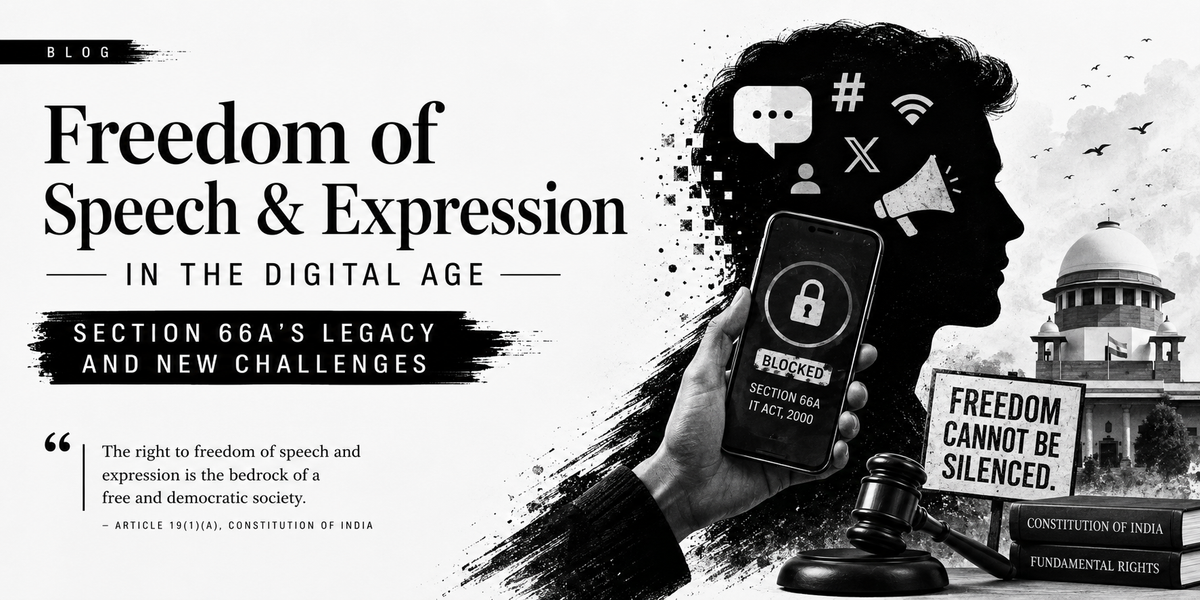
The landmark case of Shreya Singhal v Union of India stands as the primary bridge in Indian Jurisprudence, connecting online speech, vague restrictions, and Section 66 A of the Information Technology Act 2000. The above mentioned case directly dealt with the freedom stipulated under Article 19(1)(a), declaring Section 66 A as unconstitutional on the grounds of being vague and arbitrary. Section 66 A includes within its purview any information deemed as “grossly offensive” to be punishable with a prison term and fine, placing an unfair discretion in the hands of the authorities. This case reiterated that any restriction that does not fall squarely within the ambit of Article 19(2) is unconstitutional and arbitrary being broad and undefined, hence creating a constitutional warning.
The proposed Karnataka Fake News and Misinformation (Prohibition) Bill 2025, seemed to echo similar concerns by imposing criminal penalties on speech related “illegalities”. The Bill defines “misinformation” as knowingly or recklessly making a false or inaccurate statement of fact, and “fake news” to include misquotation, distorted audio/video and fabricated content. It imposes an imprisonment of two to five years for misinformation and upto seven years alongside a Rs. 10 Lakh fine for fake news. The Bill attracted a lot of academic debate and criticism for its broad and subjective categories such as anti-feminist, anti-sanatan, and so on.
Further, in the case of Anuradha Bhasin vs Union of India, the question shifted from whether speech can be criminalised to whether online spaces themselves can be shut down. Sec 69 A of the Information Technology Act empowers the government to block websites under the pretext of public order or state security, acting as a pivotal cause for the constitutional tension between digital regulation and online speech. Anuradha Bhasin, in a way complements the Shreya Singhal case. While Shreya Singhal provides citizens with online protection, the ruling in this case, safeguards the digital access through which this speech becomes possible by mandating the proportionality test. A contemporary example of this would be the Central Government’s ban on Chinese applications in India.
Additionally, Section 79 of the same act redirects the focus from the speaker to the intermediary/platform facilitating such Free Speech. In the case of Kunal Kamra vs Union of India, the Bombay HC considered an amendment to Rule 3(1)(b) of the IT Rules 2021 where failure to comply with the fact-checking unit meant losing protection under Sec 79 as ‘safe harbour’. The government in 2021, justified the IT rules by referring to complaints of violence, nudity, child sex abuse and hurt religious sentiments to include within its purview, OTT platforms, online news, current-affair platforms and audio-visual content. It requires such private platforms like X, Meta and Youtube to takedown or block, “allegedly” unlawful content, re-creating the chilling effect of Sec 66 A by placing such discretionary power of filtering and regulating on intermediaries.
Other Challenges over the years:
Both the Northeast exodus in 2012 and the Gujarat riots are instances of digital blackouts by the Government justified by disruption to public order. Activists challenged this by arguing that digital protests require the same protection as street protests. This was mirrored in a more recent incident in 2021 when footage of Delhi-riots were censored by Twitter via shadow-banning under government directions.
On the other hand, AI-faked minister speeches and deepfakes had a major impact in Kerala, swaying bypolls and affecting Lok Sabha votes throwing light on the darkside of digital freedom, furthermore blurring the line between parody and manipulation.
There is no doubt about the digital age expanding freedom of speech, but it has also made it much easier to distort, amplify and suppress. A more pressing issue today would be the hidden algorithmic bias, also known as the “black-box” problem. While it sometimes favours controversial content to drive engagement, it can otherwise over-filter speech via automated speech or de-prioritisation of content. For example, reducing awareness posts on Breast-cancer solely due to diagrams of women’s body parts. Such content is erased out of the blue without giving the users sufficient reason, restricting speech without formally deleting it.
Conclusion:
The Information Technology (Intermediary Guidelines and Digital Media Ethics Code) Second Amendment Rules, 2026 proposed earlier this year expand government oversight via mandatory labelling of synthetic media that could possibly fabricate political endorsement, enhance blocking power and impose stricter obligations for intermediaries and users. These rules come with their own obvious benefits and drawbacks and cannot completely solve all concerns as the boundary still remains hazy with the challenges getting complex day by day. Section 66A may have been struck down, but its constitutional warning still shapes the debate around digital Free Speech today.