
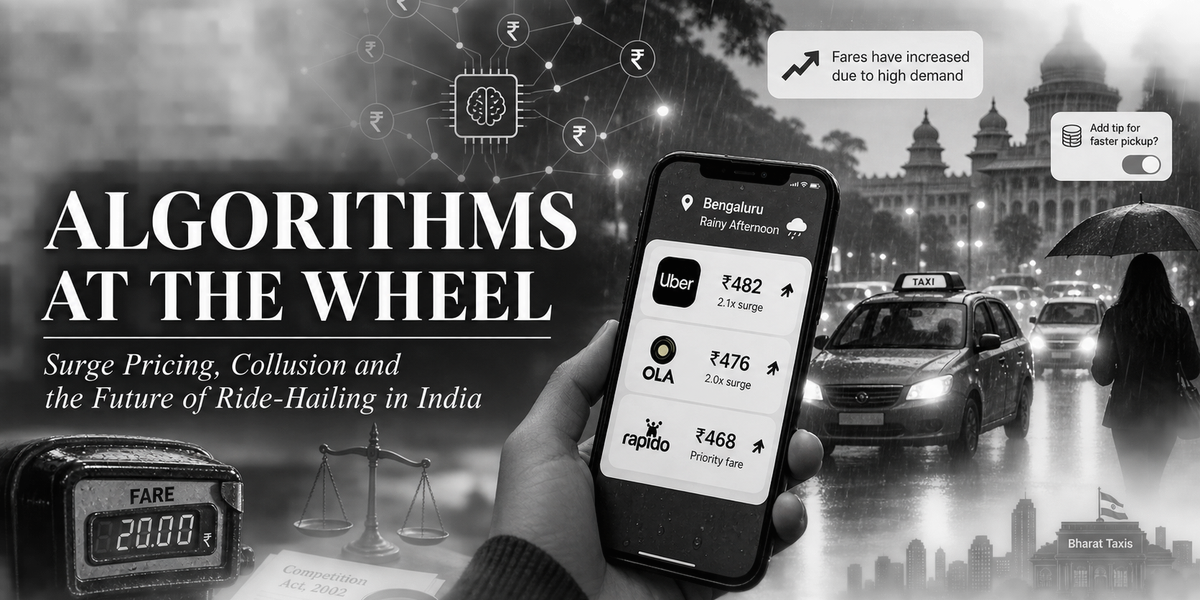
It is a rainy afternoon in Bengaluru. You open one app for a ride; the fare has doubled. You open another, and it is almost the same. The third app asks for a hike to improve “priority”. No drivers have physically met and decided this, no company executives have decided these base prices and their surge over a conference call. Nevertheless, we are left with the question of whether the prices shifts collectively are pure coincidence or collusion by an algorithm.
The question became even more pressing after increasing complaints about price disparity amongst iOS and Android users, and after the Central Consumer Protection Authority (CCPA) scrutinised the feature of advance-tipping as “unethical and exploitative”. Another major development would be the government’s announcement earlier this year of Bharat Taxis, a government-supported commercial alternative to Uber, Ola, and Rapido, prioritising driver welfare with no platform commission.
Essentially, the problem is not with high prices but with the system becoming so opaque that it blinds the customers to whether the scarcity is genuine or the result of coordinated market behaviour. On paper, surge pricing is not anti-competitive at all times. It, in fact, solves the problem by increasing demand in areas with higher prices during scarcity. The Motor Vehicle Aggregator Guidelines of 2025 allow aggregators to charge up to 2 times the base fare during peak hours.
So, what is algorithmic collusion? The Competition Act of 2002 still takes an anthropocentric approach while defining collusion, assuming that all price decisions can be attributed to humans. However, algorithmic collusion falls outside this ambit when learning systems observe market conditions and competitors’ responses to decide the price in the absence of explicit human intervention. The OECD has recognised that algorithms raise difficult questions for competition law, especially around whether traditional concepts of “agreement” and “tacit collusion” are sufficient for digital markets.
A landmark judgement witnessed in this area for India would be the case of Samir Agrawal v ANI Technologies. The allegations that arose in this case was that Ola and Uber’s pricing algorithms facilitated price-fixing among drivers because drivers had to accept fares determined by the app. The decision held supported Ola and Uber with the subsequent 2025 Market study initiated by the Competition Commission of India further proving that Uber and Ola cannot be deemed as price fixers in contravention of Section 3 of the Competition Act 2002, thus establishing a doctrinal difficulty. How do we distinguish between a classic cartel and coordination without conspiracy?
So, the real question for regulators should not simply be: “Was there an agreement?” It should be: Does the pricing architecture reduce independent competition and make fares less transparent?
In a nutshell, algorithmic collusion has left us with an invisible meter, that replaces the old, mechanical, and contestable taxi meter.